

Time is a Commercial Decision, not a Creative one

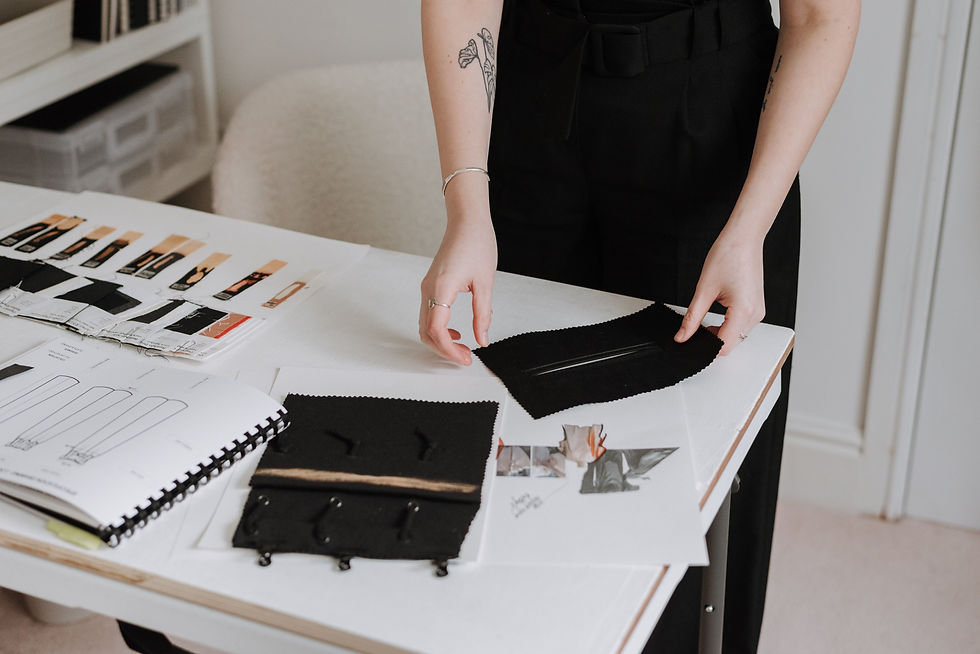
Creativity decides what a brand makes. The business has to decide when the product reaches the market, and treating that timing as a creative call is one of the costliest habits in independent fashion.
Ask most designers when a collection is ready, and they will tell you, “when it feels right”. The answer is honest, but acting on it can be expensive. Fashion is an industry built on seasons, buying cycles, production capacity and consumer demand. A collection that arrives on the designer's schedule rather than the market's needs can be beautifully made and still be commercially late.
Creativity decides what; the business decides when
Should the creative process or the commercial plan determine when a product is ready? Both. It is a little high-handed to believe a designer can work within the fashion industry without regard for its calendar or its commercial realities. The strongest brands hold the two in balance rather than letting either one dictate everything.
Part of the problem is that creative satisfaction has no natural end point. The longer you sit with an idea, the more you find to refine, rework or replace. That is the nature of creative work, but a fashion business does not exist in isolation. It depends on makers, production teams, buyers, retailers, marketing cycles and, ultimately, customers. Every timing decision has consequences for all of them.
Two shifts in thinking help. The first is to work in iterations — versions, editions, avatars — rather than expecting every idea to arrive in its final form at once. The second is for founders to see the business as something separate from themselves. Your creative instinct may be personal. The consequences of your decisions are commercial.
What should set the development clock
How long a brand spends developing a collection should be decided by commercial factors, not by how long the ideas take to settle. Those include:
Seasonality — when the product is actually worn and bought
Buyers' budgets — when retail buying budgets open, and when they close
Market and design trends — where customer taste is heading, and which categories are already saturated
Competitor strategy — who else is launching into the same window
Cost of goods — what the product must cost to make if it is to deliver its target margin
Consumer behaviour and intent — what the customer is ready to spend on, and when
Not every collection warrants the same development time. A brand should know what it is trying to achieve commercially before deciding how much time and capital to put behind it.

The compounding cost of delay
Delays rarely stay contained. If sampling runs late, production is pushed back. If production is pushed back, the selling window shrinks. And a shorter selling window means less time to sell at full price before markdowns begin, the season turns or the next collection starts competing for the same attention.
Costs accumulate along the way. Extended sampling costs more. Compressed timelines can force smaller or pricier production runs, and push a brand towards faster, more expensive freight. Throughout, money stays locked in development for longer than planned.
For a small brand, this becomes a cash-flow problem very quickly. Capital that was meant to flow back into the business through sales remains tied up in samples, fabric and unsold inventory.
When more time earns its keep
None of this means slower is always worse. More time can absolutely improve a collection commercially — but only when it is solving something specific. It creates value when it improves fit, lowers production cost, resolves a technical problem, allows the team to source a stronger fabrication, makes the product easier to reproduce consistently, or gives the brand room to test whether customers and buyers actually want it. Delay can also be the right call when the original launch window has already passed, and forcing the product out would waste its commercial potential.
The test is simple. "We need more time" should always be followed by "to achieve what?"
If the extra time does not meaningfully improve the product, the margin, the customer proposition or the route to market, it is probably just postponing a decision. Call it a lack of clarity, fear of the outcome, reluctance to sell or plain perfectionism — the effect on the business is the same.
Where perfection starts working against the business
The pursuit of perfection begins to work against the business at an identifiable point: when each further improvement to the product is worth less than the commercial cost of waiting for it. If you are reworking a neckline for the sixth time while missing buyer appointments, delaying production or pushing the product out of its season, that point has passed.
Designers need to distinguish between a product that is unfinished and one that is simply capable of further improvement. Almost anything can be improved indefinitely. The commercial skill lies in recognising when something is good enough, distinctive enough and ready enough to meet the market.
Launch, delay or let go
When a product stalls, most decisions come down to three questions: Is the product ready? Is the market ready? Does the commercial opportunity still exist?
Launch if the product meets the brand's quality standards and a viable selling window remains.
Delay if there is a clearly identifiable problem that more time can solve, and the opportunity will still be there afterwards.
Abandon or rethink if the economics no longer work, the market has moved on, the product no longer fits the brand, or the capital it would take outweighs the likely return.
The hardest part for many founders is accepting that time already spent on an idea is not, in itself, a reason to spend more.

A calendar that looks beyond the collection
A well-planned fashion calendar accounts for almost everything that has to happen around the product, not just its design and production. That means buyer appointments, trade shows, wholesale order windows and retailer delivery dates. It means photography, campaign production, PR lead times, content creation and e-commerce uploads. And it means influencer and stylist seeding, logistics, payment cycles and sell-through periods.
It should also account for the next collection — the part most often forgotten. When one collection keeps slipping, it eats into the development time and working capital of the one that follows. Eventually the whole business begins to operate reactively.
Discipline without compromise
Many independent designers work to their own creative rhythm, and they should not have to give that up. The answer is to put boundaries around the process rather than around the creativity. Ideation can stay completely free while sourcing, sampling, costing and production run to firm deadlines.
It also helps to separate exploration from collection development. Not every idea needs to become a SKU. Experimentation can continue alongside a commercial range that keeps moving forward. Discipline does not have to make the work less creative; often it forces clearer choices.
Independent brands need not follow the traditional fashion calendar to the letter. They can set their own rhythm. But that rhythm has to be predictable enough for suppliers, retailers, customers, marketers — and the business itself — to plan around.
Before you commit another month
Before committing another week or month to a product or collection, a founder should be able to answer these honestly:
What exactly will this additional time improve?
Will the customer see or value that improvement?
Will it improve my margin, my quality or my ability to sell?
Am I solving a real problem, or avoiding a decision?
Which selling window will I lose by waiting?
What happens to production and delivery timelines?
How much more cash will stay tied up?
Will this delay affect the next collection?
Would a buyer care about the change I am making?
If I were seeing this product for the first time today, would I still invest another month in it?
Sometimes the most commercially intelligent decision is not to perfect the product, but to release it, learn from it, and make the next version better.


Comments