

Designer Spotlight: Dhanya Sugathan of Origin & Objects


After more than two decades making clothes for other businesses, Dhanya Sugathan, the founder of Origin & Objects, has built a label around handwoven textiles, the people who make them, and the supply-chain rigour she spent a career learning.
Plenty of fashion labels take inspiration from Indian handloom. Far fewer use cloth that has actually been woven by hand. A digital print can copy the look of a weave, but not its texture, its small irregularities or the skill of the person who wove it. Dhanya Sugathan built Origin & Objects around that difference. "If we say handwoven, it is handwoven," she says. Dhanya came to handloom after more than 20 years in design, product development, sourcing, production and quality, working with businesses and markets around the world. She knows what it takes to turn an idea into a viable product.
Origin & Objects required her to keep that knowledge and also start again. "Working closely with handloom and craft," she explains, "asks for a different kind of listening." That listening means respecting material knowledge, human knowledge and a degree of unpredictability. It also meant learning to bring the cloth and the maker into the design process much earlier.
A question that stayed

Over those years, she watched fashion move towards faster turnarounds, lower prices and higher volumes. That direction leaves little space for anything that takes time to make. Working from India, she was surrounded by the opposite: handwoven textiles, natural raw materials, and craft knowledge that had evolved over generations. The country, she felt, had far more to offer than cookie-cutter solutions.
The question she kept returning to was whether all of this could reach a global audience as something current. She was specific about the form it should take: "Not as nostalgia, and not simply as preservation, but as something alive and desirable in a contemporary wardrobe."
Her first response was Artizenery, a business built around supply-chain solutions with artisan communities. Its work was finding ways for artisans' skills to meet contemporary markets on terms that were both meaningful and commercially sound. Artizenery supplied pieces of the chain. Origin & Objects let her take that thinking all the way to market and show what she had in mind. The label brings material, craft, design and a way of living together, and Dhanya sees it as the tangible form of the questions Artizenery began with.
From the loom

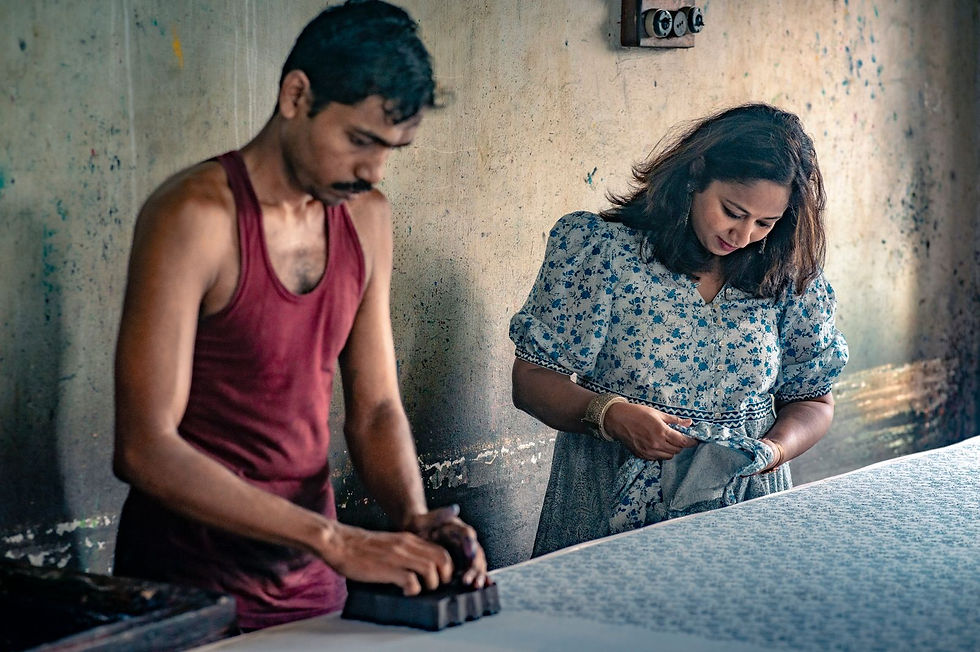
At Origin & Objects, the making is part of the object, not a story attached to it afterwards. The label develops many of its textiles from the yarn up, working on the construction of the fabric down to the reed and pick. As a result, textile development and garment development are effectively one process. Dhanya begins with an intention: a particular weight, texture, colour or feel. Then the fabric shows what it can actually do. Sometimes it behaves as she pictured, and sometimes it suggests something else.
"There is my intention for the fabric, and then there is what the fabric itself wants to become,"
Dhanya observes. The design tends to settle somewhere between the two.
Once woven, many of the fabrics are washed. Only then can you tell what the cloth is really like: how soft it feels in the hand, how it hangs, what its surface looks like and how it moves. Those qualities guide what it becomes. Some cloths call for structure; others need room to move or gather. Dhanya seldom starts with a silhouette and then goes looking for a fabric to fill it.
The weavers are part of that exchange from the start. Work with a community begins with conversations about what it makes particularly well, what knowledge is held there, and what the makers themselves are interested in trying. Dhanya may arrive with an idea for a colour, yarn or construction. A weaver may propose another way to get there, or explain why something won't behave as she imagines. Those conversations often lead to directions she wouldn't have found alone. Because the textile shapes the garment, the makers' input carries through into the collection.
For Dhanya, the maker's knowledge and the ecosystem around it come first. Only once that is understood does she look at what can change: the scale, the yarn, the colour, the combination of materials. "I don't believe preserving a living craft means freezing it in time," she adds. A craft stays alive by finding new relevance and new markets, as long as that change respects where it came from.
The silhouettes add another layer. They draw on years of looking at clothing across cultures, through international trade and travel. Dhanya looks at handmade textiles and how they can belong globally, and influence tailored constructions and global silhouettes.
Rigour at a different pace

Asked about the constraints of handloom and small-batch production, Dhanya answers with an analogy:
"For me, discovering the possibilities of handwoven textiles has been a little like leaving a chef in an extraordinary organic market."
She notices the possibilities first. Small quantities leave room to experiment, and close work with passionate makers opens up options that high-volume production often doesn't allow.
The difficulty is time. Handwork is less predictable and things take longer, so the planning has to make room for the making itself. Small-batch, she points out, does not mean last-minute. Textiles take a long time to develop, so many decisions have to be made well in advance. Her years in supply chain have become more useful here. She applies the same rigour to a very different rhythm of production.
The model has also sharpened her thinking about longevity. A piece should stay relevant well beyond a short selling window. Margins matter because the whole ecosystem has to survive. The business needs to be sustainable, quality can't be compromised, and everyone involved in making the product has to be paid fairly. She is candid that she is still learning how to hold all of that together.
Clothes for a full day

Dhanya was born in Kerala, grew up in Chennai and works in Bangalore. Her career has also kept her travelling between very different environments and working with people around the world. As a result, tropical weather, movement, layering and versatility aren't items she adds to a design brief. They are simply how she thinks. She wants clothes that carry someone through a meeting, a journey, lunch and an evening out without asking them to become a different person for each. That shapes the weight and breathability of the cloth, the ease in a cut, the way pieces layer, and how they feel against the body.
It shapes how she plans collections too. Dhanya wants each garment to be cherished and worn for a long time, so a new collection shouldn't make the previous one irrelevant. Every piece should feel complete in itself, while later additions let it take on another form. A shirt from one collection might find a new partner in a skirt introduced later, with colours, textiles and proportions carrying across. She also deliberately leaves room for the wearer to combine pieces with what they already own, rather than prescribing one finished way to wear them.
The discipline of editing
Taking Origin & Objects into wholesale and international markets meant translating an intuitive brand into systems a buyer could read. With SatatKi, that process also began with conversation. They discussed who the brand is, what it is really trying to say, and how to communicate that without losing what makes it distinctive. From there the work moved into the practical language of wholesale: range architecture, pricing, delivery, presentation, and where the label sits within a store. The aim was a commercial structure that supports the creative work instead of sitting apart from it.
Range planning brought its own lesson. Dhanya comes from an industry where developing many options is routine. By her own admission, she works "in multitudes", and at launch she wanted to do everything. SatatKi helped her narrow that down to the essence of the offer: which pieces needed to be there, how they worked together, and how to make choices clearer for both the customer and the buyer. The campaign shoot extended that work. The goal was less about photographing clothes and more about making the world of Origin & Objects visible, with product, styling and imagery speaking the same language.
It is a lesson she has kept close: "Creativity can be expansive, but a brand needs editing." Putting those boundaries in place has given her a clearer sense of where the label can experiment and where it needs to be precise.


Comments